Tuesday, 10 March 2015

All kinds going on this week! 10-03-2015

This week there were four different activities for NCVs to choose from. Paul opted for the  "inspiring events"  training session at Pateley Bridge Council Chambers, focussing on ideas for making our events work better in future. The NCVs could have joined him but, instead, most went for a more outdoors approach - an excellent idea given the beautiful sunny day. Two NCVs took the less inviting option of staying in the workshop, sharpening tools. This is a rather tedious process but we are very grateful to Jan and Dave for giving up their day in the sun to ensure that our tools are now all nice and sharp and ready for future use. The others split into two groups as follows......

Task one: Tree planting at Ramsgill

I am under strict instructions from her with a bee on her bonnet, to keep this brief, so…

The Task: plant 130 trees and some willows near the sand martin wall at Gouthwaite to hide a brand new sand martin wall from the road.

People: 1 Leader – Barry, waller and tree planter extraordinaire. 6 additional workers and 1 drone, comprising 2 volunteers from Nidd Birdwatchers and the rest from the NCVs.

Process: A demo by Barry. Stop for cake and coffee (with much thanks to Alwin). Plant trees. Stop for lunch and eat even more cake. Examine the sand martin wall. Head for home.

The team listen to their leader then get busy.
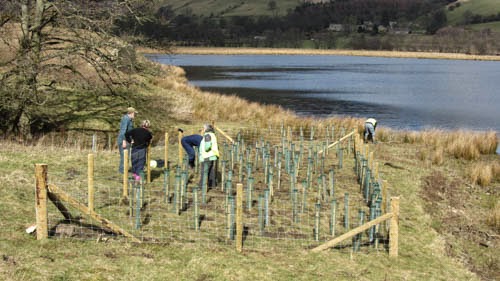
The tree tubes (and saplings) are soon in place in the enclosure.

What a great venue for a Tuesday morning!

An excellent day (well, half day really) for both weather and work. And cake! Thanks go particularly to Yorkshire Water for fencing off the area and providing the trees.

Tony (aka 'The drone')

Task two: Log shifting in Fishpond Wood

The Heritage skills students and four NCVs walked up to Fishpond Woods to rescue some of the logs from the many brash piles. These are going to be made into charcoal by the wood's owner once he purchases a charcoal burner. Armed with saws and wheelbarrows the small band of volunteers spent a happy though tiring day sawing, shifting and piling wood (see photos below).

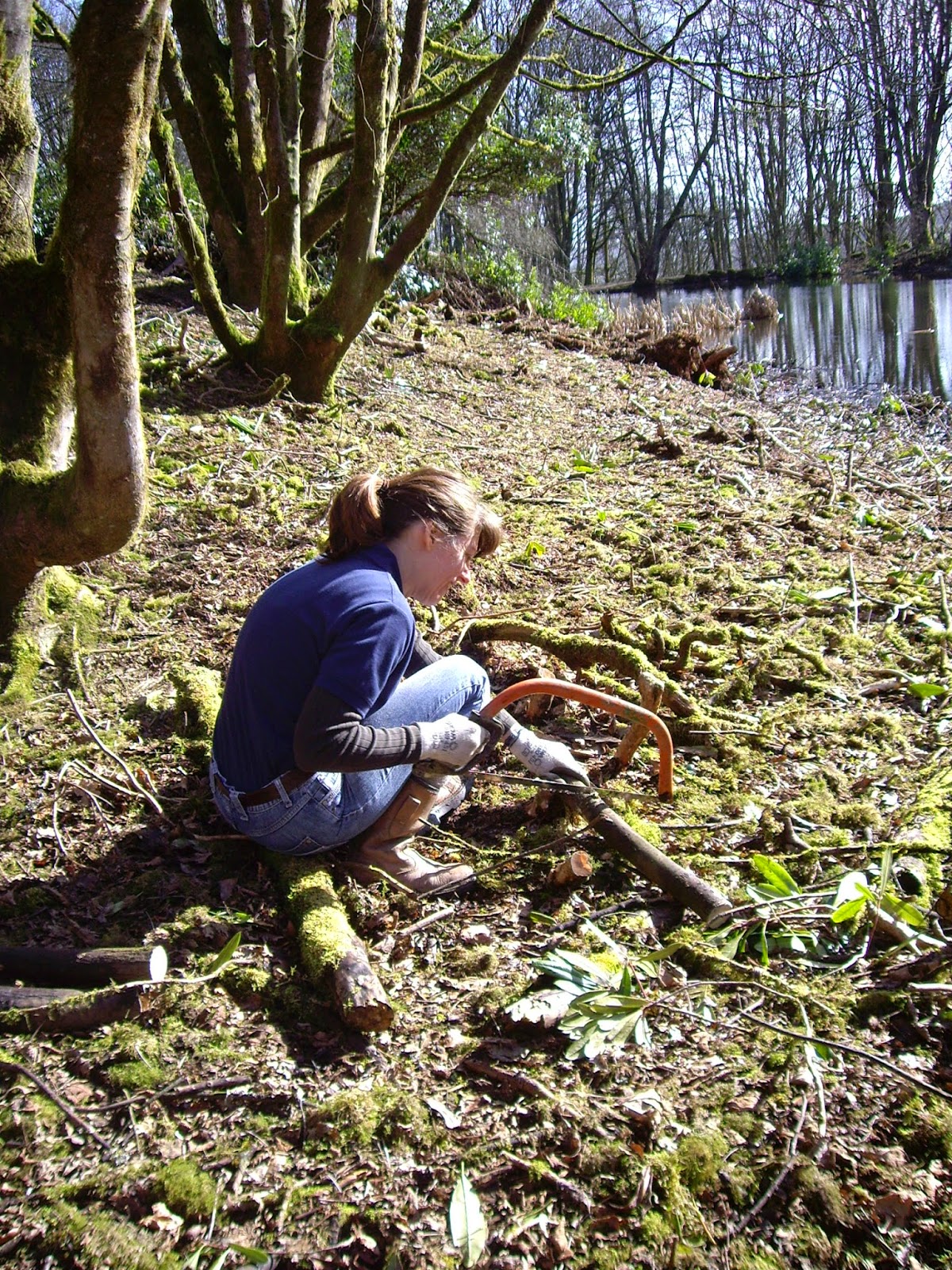
First we had to select appropriate logs and start sawing them up. 
(20 - 80 cms long and about the width of an arm is ideal 
according to Osian's smart phone google search on site!)

The students shifted the logs in barrows, taking them around the end 
of the lake to the stacking department. During the afternoon supply exceeded the capacity of the 'piler upper' who began to disappear under the incoming tide of wood.

 At lunchtime some decided to snooze in the sun....
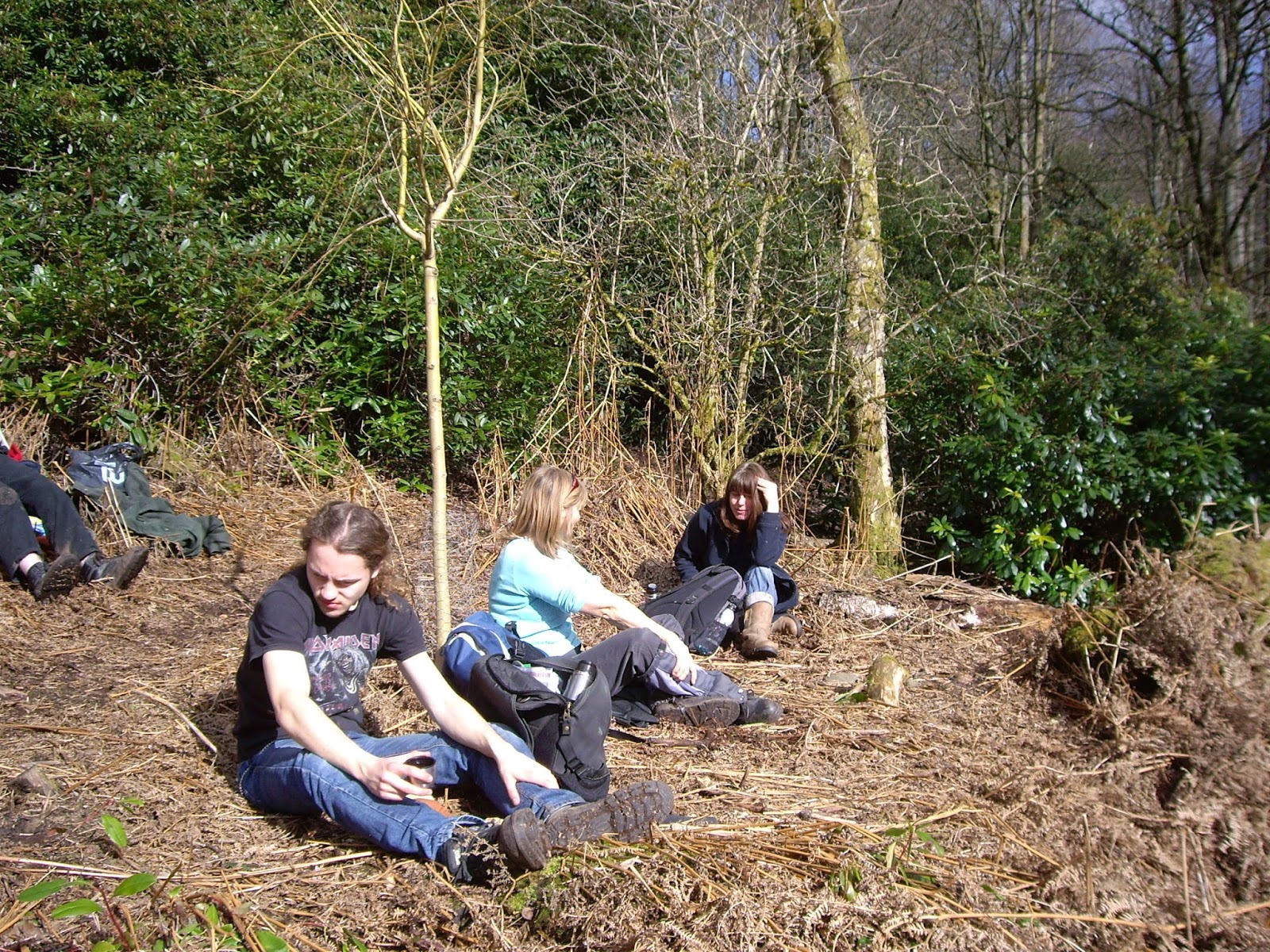
....whilst others chatted or pondered by the lake side.
(PS Thanks to Audrey for the flapjack)

By the end of the day we had two large log piles waiting by the path, 
ready for the charcoal burner when it arrives.
It has to be said that the dimensions of some of the last logs of the day were not exactly to google's instructions!!

The team felt very pleased with the fruits of their labours - 
and were well ready for a sit down!

Ros


Tuesday, 3 March 2015

Conservation and biodiversity apps training session: 03-03-2015

This morning 8 NCVs and the Heritage Skills students attended an interesting training session at the Pateley Bridge council chambers about conservation and biodiversity apps, led by Dr Anita Glover. Anita is a biologist with a specialism in bat ecology from the University of Leeds. She is very interested in 'Citizen Science' which aims to get amateurs interested in science issues.

The first part of the morning involved Anita showing us the various apps and online tools available and then, after a break, we got the chance to investigate the different apps on our smart phones and tablets.
In general, recording apps (i.e. those that allow you to record different species seen and share this information with others) are often free, whereas ID guides are usually charged for.  Often the recording apps will provide an element of an ID guide within them.  Apps that were covered in the course included:

Recording apps:

-          Apps to record specific native taxa, e.g. iRecord ladybirds, iRecord butterflies and mammal tracker

-          Invasive species recording apps such as plant tracker and aqua invaders
Plant tracker can also be accessed online as a website and shows distribution maps of invasive species. These maps don't seem to be able to be accessed on a smart phone.

-          Apps to help track plant health, e.g. the forestry Commission’s tree alert (useful to record instances of tree diseases spotted) and OPAL’s tree health survey

-          Apps that allow you to set up customised survey forms for your own surveys, e.g. Fieldtrip GB


ID guides:

-          ID guides developed by Isoperla, e.g. Wild Flower ID, tree ID and herptile ID (£2.99 each or £8.99 for a fixed bundle of 4 - 2 tree guides, a flower guide and a fungus guide.)

-          Collins bird guide (£14.00 for iphones and ipads only)

-          ispot (not an app, but available as an online tool which allows you to post up photos for confirmation of identification)

Thanks to the AONB office for organising this event. I finished off the day by going home and buying the Isoperla bundle and bird ID apps which are excellent for using when you are out and about. I will no longer have to carry heavy ID books and charts!

Ros E. 

Tuesday, 24 February 2015

Ellington Banks - visit number three: 24-02-2015

On a fresh winter’s day that promised to be full of showers 12 NCVs, Paul, 3 heritage skills students and their supervisor met at Ellington Banks for the third instalment of conservation work and great crested newt habitat improvement. The MoD ecologist, John Black, gave us a quick safety briefing and then it was off to work in good sunshine. Not a cloud to be seen anywhere.

 NCVs working hard in all directions.


Graham eagerly took on solo fire duties with the assistance of a ‘large fire starter’ provided by Paul. The rest of us broke up into smaller groups sawing and lopping in the unexpectedly warm sunshine. In an impressively short space of time the ‘fire on the bog’ was established and was fed by the fruits of everyone’s labour.

No small task to get a fire going in the centre of a pool of water.

Brash production increased significantly when Paul “2 chainsaws” Mosley and John set to work on the larger trees. All the while a small number of brash piles were being created as habitats for wildlife.
A picture of elegance - who is the muddiest? This is the best of the brash piles so far.
During the morning break John provided an informative outline on the life-cycle of a great crested newt. Who would think they could travel so far and are proficient diggers in search of appropriate winter hibernation locations.
Major Paddy Ennis, the officer responsible for three army sites including Ellington Banks, came up to inspect the work and thank us for our efforts. He kindly offered to make the site available for an evening for those interested to see the newts later in the year. 

The NCVs meet Major Ennis.....

...and then pose for a whole group photo. 
Which of them look fit enough to join the army?

After a team photo it was back to work, except now with the company of the much promised rain / sleet / snow showers.

A quick lunch (under the shelter of what trees we hadn’t sawn down) was taken and a highly productive afternoon finished with a short walk around the perimeter of the conservation area led by John, who provided insights into some of the activities and armoured ‘furniture’ on other parts of the site.
This old tank could do with some conservation work!
As we left, with the bonfire burning itself out, you could see the large area that had been cleared around the two ponds to benefit the great crested newts.


Osian

Wednesday, 18 February 2015

Hedge Laying Training and Ellington Banks re-visited: 17 and 18-02-2015

The NCVs were out on two days this week - some taking part in beginners' hedge laying training, others doing advanced hedge laying training and more continuing work at Ellington Banks......

Monday

Today Jasper Prachek, a professional hedge layer, ran the day's advanced hedge laying training at Low Lindrick Farm near Ripon. Six NCVs took part in this and the photos below give a flavour of the day. The weather stayed dry and we really managed to hone our skills, first learned two years ago. Jasper did an excellent job of making sure we achieved a level to be proud of without losing any fingers! 


Jasper shows the group the good and bad points of a hedge recently laid during a competition. The picture on the right shows what we were meant to be aiming for.

This was what we were starting from - so plenty of work lay ahead.

The first pleach of the day took place 
under close scrutiny.

Dave sawed off one of the stubbs.

Jasper showed Jan how to lay a tree around a post.

You need to keep looking at your hedge to make 
sure it has no gaps and is even on both sides.

Ros E.

Tuesday

Eleven eager beavers met John Black from the MOD at Ellington Banks to continue the clearing of saplings from around the ponds.   For those who had not been to the site before John gave us a brief introduction and pointed out the risks involved.  In glorious sunshine we quickly set to work with our trusty loppers and saws.   

 Everyone spread out - the saplings were easy to spot this week!!

 Chris set to work on a new brash pile....

...whilst Terry played with fire. 
No explosives were used in the making of this blaze.

Lunch time at last.

By 2pm a halt was called to cutting and all that remained to do was finish off the brash piles and watch the fire burn.  John explained that the best time to treat the stumps with herbicide is when they have produced some fresh growth, which he will do in May. 

By end of play there was a 'street' of Great Crested newt 
hibernation homes around the pond. 

The pond now looks good - but what has caused these ridges 
that have been revealed? John is going to find out for us.

Last job of the day - watching the fire die down. 
No shortage of volunteers for that task!

Anita

Meanwhile back at Low Lindrick farm another group undertook a day of beginners' hedge laying training with Jasper. This included the Heritage Skills students and a tutor, as well as some from other volunteer groups. The photos tell the tale.....

 The day started with the inevitable talk about 
health and safety regarding tools.

Everyone had to start by fronting up the hedge 
to remove most of the vegetation.

Once just a few stems remained Osian got busy 
with his saw in order to lay one flat.

Two of the students both worked with Jasper learning how to keep 
the saw blade flat. Two ended sawing is better than one.

Tom set his first rail in place.

By close of play the hedge was really looking good.

Tuesday, 10 February 2015

Scrub clearance at Timble Ings: 10-02-2015

Yet another cold and bright day dawned this morning - perfect for the day's task. We met at Anchor Farm at Timble Ings and walked a mile into the Yorkshire Water woodland in order to reach the dragon fly ponds where we regularly visit to clear out any encroaching saplings. There was a good turn out - 19 NCVs joining Paul and the Heritage skills crew.

Paul started the day with a clear set of instructions. 
Or was it a game of Simon Says?

Underfoot was boggy, so wellies were the order of the day. Those without needed to circumnavigate here and there to avoid getting wet. The workers split into smaller gangs: one to clear around the three ponds; one to thin out the saplings along the stream-side and a third to cut down scrub growing on the nearby bog.

 The saplings around ponds a and b were hard to spot in the reeds.

This one was hoping it had disguised itself well 
enough to be overlooked. We can see you!!

The saplings around pond c were much more obvious.

This team of NCVs felt they'd done such a good job 
that they could celebrate by stopping for lunch.

Those on bog clearance were also working hard at it....

.....as were those along the stream-side.

Ros K decided to have a lie down on the job.

Plenty of material was generated for brash piles, some of which were easier to construct than others, depending on the size of the saplings.

This brash pile ended up quite tightly packed....

...and this excellent one looked like a hedgehog, 
complete with a snowball for an eye.

Two more new hat bobbles appeared today to join Anita's mouse bobble. Thanks to Anita for making them for us. Thanks also to Audrey for a welcome tin of flapjack.

Ros  K's bobble is a ladybird but her sewing skills 
led to it hanging down too much at the back.

 
Ros E's busy bee bobble is so heavy it regularly 
makes the hat slide down and obscure her vision.

All around were lovely examples 
of mosses and lichens.


Ros E.